


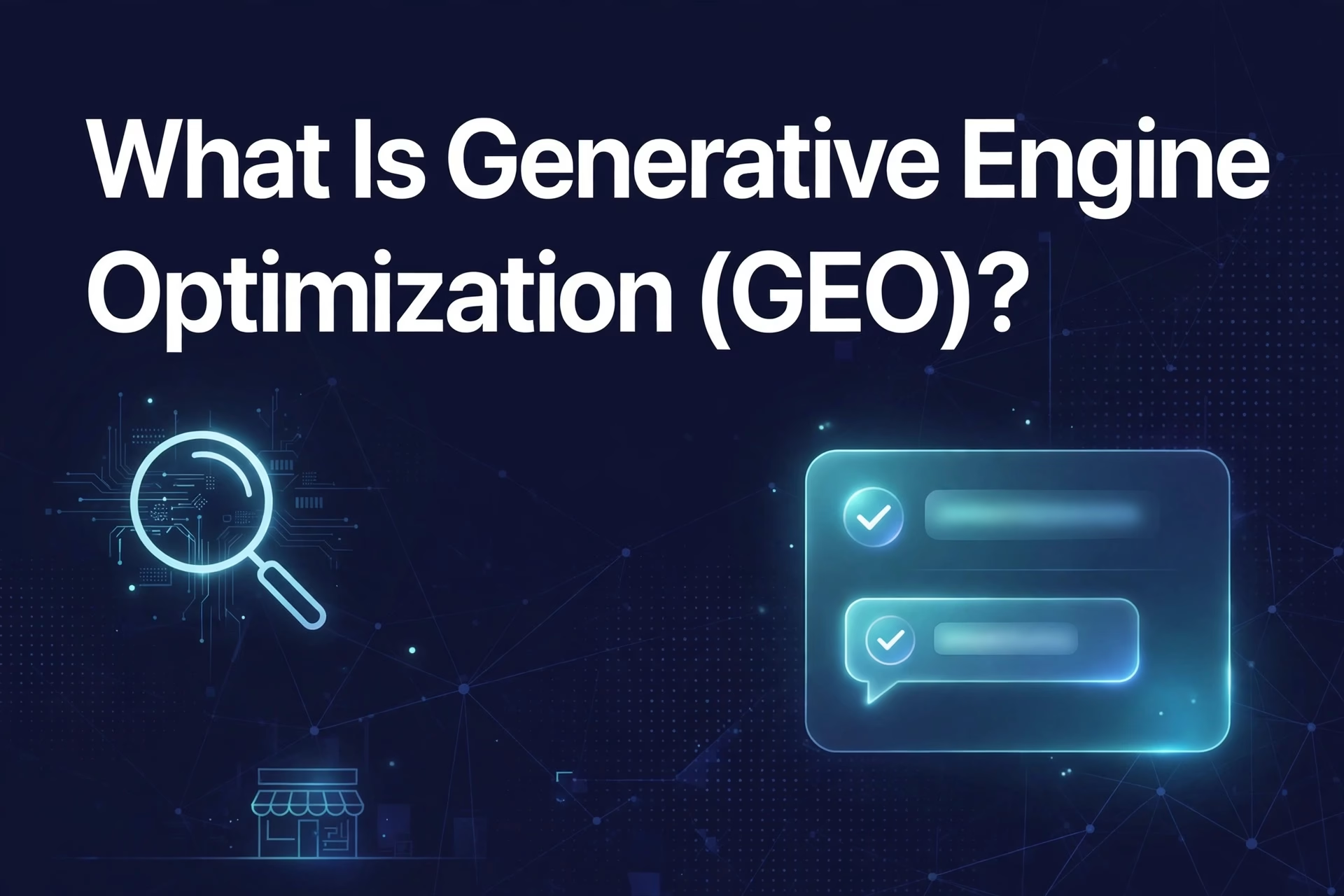
Search is changing in front of our eyes. For years, the goal was simple: rank on page one and earn the click. Now, many people get their answer directly from an AI generated summary, a chatbot reply, or an AI overview at the top of the results page. They may still click through to a website, but often they read the summary first and only visit the sources that look most useful and trustworthy. Generative engine optimization, usually shortened to GEO, is the work of making your business visible in that new kind of answer.
This guide explains generative engine optimization in plain language, without hype and without promises. It covers what GEO is, how it differs from classic SEO, what AI systems tend to favour when they choose sources, and a practical checklist a small business can actually follow. If you already invest in SEO, you are not starting from zero. Much of GEO builds on the same foundation, with a few important changes in emphasis.
What Generative Engine Optimization Actually Means
Generative engine optimization is the practice of improving how a website, brand, or piece of content appears in answers produced by generative AI systems. Those systems include AI overviews in search engines, AI chatbots, and voice assistants that summarise web content instead of simply listing links. When someone asks a question, the system retrieves information from web pages, weighs which sources seem relevant and reliable, and then writes an answer in its own words, often with citations or links to the sources it used.
The name is newer than the idea. The term generative engine optimization was introduced in a research paper in 2023, and it has since been used alongside related terms such as answer engine optimization and AI search optimization. Different tools and vendors use different labels, and Google has described optimizing for generative AI search as still being SEO at its core. The label matters less than the shift behind it. Search results are no longer only a list of blue links. They are increasingly answers, and being cited inside an answer is becoming a valuable form of visibility.
For a small business, GEO does not replace your website, your Google Business Profile, or your classic search rankings. It is an extra layer on top of them. A business that is invisible in classic search is unlikely to be cited by an AI system either, because those systems draw on the same web. The practical goal is to make your best content easy for both people and AI systems to find, understand, and trust.
How AI Search Answers Differ From Classic Search Results
In classic search, a user types a query, scans ten results, and chooses one. Ranking position, title, and description decide most clicks. In AI search, the system does much of that scanning for the user. It reads several sources, compares them, and presents a single synthesised answer. The user may never see your page title at all unless your site is cited or linked inside that answer.
That change has three practical consequences. First, clarity beats cleverness. A page that answers a question directly, in plain sentences, is easier to summarise than a page that hides the answer behind long introductions or vague marketing language. Second, structure matters more. Headings, short paragraphs, lists, and tables help a system extract the relevant part of a page without misunderstanding it. Third, trust signals carry more weight. A system that must choose between competing sources will tend to favour pages that show expertise, original detail, and consistency with other reliable sources.
None of this means that ranking no longer matters. Pages that rank well in classic search are often the same pages AI systems retrieve first, because retrieval still depends on indexing, relevance, and authority. Think of AI answers as a second contest run on top of the first one. You still need to be found before you can be cited.
Generative Engine Optimization vs SEO: Same Foundation, New Layer
It helps to see GEO and SEO side by side rather than as rivals. Classic SEO aims to earn rankings and clicks from search engines. GEO aims to earn citations and mentions inside AI generated answers. Both depend on relevant content, technical health, and authority, but they reward slightly different strengths.
| Factor | Classic SEO | Generative engine optimization |
|---|---|---|
| Main goal | Rank high and earn the click | Be retrieved, understood, and cited in an AI answer |
| What the user sees first | A list of results with titles and descriptions | A synthesised answer, sometimes with source links |
| Content strength | Depth, relevance, and keyword coverage | Direct answers, clear structure, and quotable facts |
| Trust signals | Links, authority, and user behaviour | Consistent facts, named expertise, and corroboration across sources |
| Measurement | Rankings, traffic, and conversions | Citations, brand mentions, and referral traffic from AI tools |
The overlap is large, and that is good news for a small business. A well written service page, a genuine blog post, and a clean technical setup help both goals at once. The difference is mainly in how you write and structure the content. For SEO alone, a long detailed article can succeed even if the key answer sits halfway down the page. For GEO, that answer should also appear early, in a form that can be lifted and quoted without losing its meaning. For background on the term itself, see the generative engine optimization overview on Wikipedia.
If you are weighing whether this kind of work is worth the investment at all, our guide on whether SEO is worth it for a small business sets out the same honest test: GEO, like SEO, pays off when it brings in the right enquiries over time, not when it produces a single impressive screenshot.
What AI Systems Look For When They Choose Sources
No AI provider publishes a complete formula for how sources are chosen, and any agency that claims to know one exactly should be treated with caution. What is clear from public guidance, research, and observation is that several qualities recur again and again. Treat the list below as a working checklist, not as a guaranteed ranking formula.
First, relevance to the exact question. A page that answers one question thoroughly is easier to cite than a page that covers ten topics thinly. If your page is about local SEO for dentists, it should answer that question in detail, not spend half its length on general marketing theory. Second, direct and quotable answers. Short summary sentences, definitions, and step by step instructions are easy to reuse accurately. Third, original and specific detail. Generic advice that appears on a hundred sites gives a system no reason to prefer your page. Real examples, genuine process detail, and answers drawn from your own experience stand out.
Fourth, expertise and accountability. Pages that name the business behind them, explain who wrote the content, and link to real service pages look more trustworthy than anonymous pages with no author, no contact details, and no supporting pages. Fifth, consistency. When your business name, services, and key facts appear consistently across your own site and other reputable listings, a system has more confidence that the information is correct. Sixth, freshness where it matters. Prices, tools, and platform features change, so pages that are clearly dated and updated are easier to trust than pages that quietly go stale.
Finally, crawlability and structure. If a system cannot read a page properly, it cannot cite it, however good the content is. Clean headings, readable text rather than text trapped inside images, and a technically healthy site all help. That is why GEO work always starts with the same foundations as good SEO services: content, structure, and technical health working together.
A Practical GEO Checklist for a Small Business Website
Use this checklist on your most important pages first, not on every page at once. Start with your homepage, your main service pages, and the handful of blog posts that already bring in traffic or enquiries.
- Answer the page’s main question in the first two or three paragraphs, in plain language, before any background or sales message.
- Use clear headings that match the questions customers actually ask, such as “What does this service include?” or “How long does it take?”
- Add a short summary or key points section near the top of longer guides, so the core answer can be understood at a glance.
- Write definitions in one or two sentences when you introduce a technical term, rather than leaving the reader to guess its meaning.
- Include specific, honest detail: what is included, what is not included, who the service suits, and what happens next.
- Keep facts consistent across pages, and update a page when a fact changes instead of leaving an old version live.
- Show who is behind the content: a real business name, real service pages, and a clear way to contact you.
- Use structured data where it fits, such as FAQ or service markup, so machines can parse questions and answers correctly.
- Make sure pages load well on mobile and are not blocked from crawlers by accident.
- Link related pages together so a system, and a reader, can follow from a general guide to the specific service page.
Notice what is not on this list: stuffing a page with the phrase “generative engine optimization” dozens of times, buying bulk AI citations, or publishing dozens of thin pages in the hope that one gets picked up. Those tactics do not build trust, and they usually hurt the classic rankings that GEO depends on. A small business wins in AI search the same way it wins in classic search: by being the clearest, most helpful, and most credible answer to a real question.
Content Formats That Work Well in AI Answers
Some formats are naturally easier for AI systems to summarise, because they already break information into clear, self contained pieces. You do not need to use every format on every page. Choose the format that fits the question.
Question and answer formats work well, especially FAQs that give substantive answers rather than one line replies. A FAQ that says “It depends” without explaining what it depends on is useless to a reader and to a system. A FAQ that lists the factors, explains each one briefly, and ends with a clear recommendation is quotable. Comparison tables work well for “X vs Y” questions, because they put the differences side by side in a form a system can read without guessing. Step by step checklists work well for how to questions, because each step is a distinct, reusable piece of information.
Definition plus example is another strong pattern. Define a term in a sentence, then immediately show what it looks like in practice for a business like the reader’s. Lists of pros and cons, short case descriptions without invented results, and “who this suits and who it does not suit” sections all help a system understand context, not just facts. That context is often what separates a cited source from a skipped one.
Blogging remains one of the best vehicles for this kind of content, because a blog lets you answer one question per post in depth. Our guide on whether blogging is worth it for a business explains when that investment pays off and when a business is better served by improving service pages first. Either way, the rule is the same: one clear question, one thorough answer, one page.
Technical Basics That Support AI Visibility
Technical work rarely makes exciting reading, but it decides whether good content can be found and read at all. Start with the basics and check them before spending money on specialist GEO tools.
First, confirm your pages are indexed and reachable. A page that returns an error, is blocked by a robots rule, or is hidden behind a login cannot be cited. If your website is not showing up on Google, fix that problem first, because the same visibility problem will affect AI retrieval. Second, keep page speed and mobile usability in reasonable shape. Slow, broken mobile pages lose readers and are less likely to be preferred as sources.
Third, use clean heading structure. One main title per page, logical subheadings in order, and text in the page body rather than baked into images. Fourth, add structured data for FAQs, services, and local business details where it genuinely matches the visible content. Structured data does not guarantee a citation, but it removes ambiguity about what a page is about. Fifth, keep your site architecture simple: service pages linked from the homepage and from relevant guides, blog posts linked to the services they discuss, and no important page buried several clicks deep with no links pointing to it.
One more technical point deserves emphasis. AI systems can only cite content they are allowed to read. If you block AI crawlers entirely, your pages will not appear in AI answers. If you allow them, you accept that summaries of your content may appear without a click. That trade off is worth deciding deliberately, not by accident. Most small businesses benefit more from being cited than from being invisible, but the choice should be made knowingly, and it should be consistent with how you treat search crawlers generally.
What Not to Do: GEO Mistakes to Avoid
The fastest way to waste a GEO budget is to chase visibility tricks instead of fixing content. Watch for these common mistakes.
- Publishing thin, near duplicate pages for every variation of a question, in the hope that volume alone earns citations. It usually earns thin content problems instead.
- Writing for a system instead of a person, with repetitive keyword phrasing that no customer would trust or enjoy reading.
- Inventing statistics, rankings, or client results to sound authoritative. AI systems cross check claims against other sources, and a false claim damages credibility in both search and AI answers.
- Buying citations, mentions, or links from low quality networks. These are the same spam signals that harm classic SEO, and they do not create genuine authority.
- Rewriting good pages so often, or so drastically, that rankings and existing citations are lost. Update for accuracy, but do not churn content for its own sake.
- Expecting instant results. AI visibility, like classic SEO, builds over time as content is indexed, retrieved, and cited repeatedly.
A related mistake is hiring on hype. If an agency promises a fixed number of AI citations, a guaranteed position in AI answers, or secret GEO tactics it cannot explain, ask the same questions you would ask any SEO provider. Our guide on questions to ask an SEO agency before hiring is a useful screen here too, because the honest answers for GEO sound much like the honest answers for SEO: process, examples, timelines without guarantees, and clear reporting.
How to Measure Whether GEO Work Is Helping
Measurement for GEO is still maturing, and that honesty matters. There is no single dashboard that shows every AI citation perfectly. Use a combination of signals, and judge them over months, not days.
Start with referral traffic from AI tools in your analytics, where it is identifiable, and with brand mention checks: search AI chatbots and AI overviews for your main questions and note whether your business appears, and in what context. Track classic signals alongside them, because they move together: rankings, organic traffic, and enquiries. If AI citations rise but enquiries do not, the content may be reaching the wrong questions. If enquiries rise but you cannot attribute them cleanly, that is still a good outcome, provided you are tracking enquiries properly in the first place.
Set a simple 90 day starting plan. In the first month, fix the foundations: confirm indexing, improve your top five pages using the checklist above, and add a clear summary and FAQ section to your most important guide. In the second month, publish two or three question led posts that answer real customer questions in depth, each linked to the relevant service page. In the third month, review what changed: which pages are being cited or mentioned, which questions still produce no citation, and which pages need updating. Then repeat the cycle on the next set of pages, rather than starting a new tactic from scratch.
Time expectations should stay realistic. Classic SEO already takes time to compound, and our guide on how long SEO takes to work explains why patience is part of the method, not an excuse. GEO follows a similar pattern. Early wins are possible on narrow, specific questions, but broad competitive topics take sustained work, and any provider promising overnight AI dominance should be treated with the same scepticism as one promising overnight page one rankings.
Frequently Asked Questions
Is generative engine optimization replacing SEO?
No. GEO builds on SEO rather than replacing it. AI systems retrieve content from the web, and the pages they retrieve tend to be pages that are already indexed, relevant, and authoritative. A business that neglects classic SEO, technical health, and content quality will struggle in AI answers too. The sensible approach is to keep doing good SEO and add GEO emphasis: clearer answers, better structure, and stronger trust signals on your most important pages.
Do small businesses need GEO, or is it only for large brands?
Small businesses can benefit, sometimes more than large brands, on narrow and local questions. An AI system answering a specific question, such as how a particular service works or what it includes, does not need a global brand. It needs a clear, credible, specific answer. A local or niche business that publishes that answer well can be cited ahead of a larger competitor with only generic content. Local visibility also still depends on local foundations, which is why our local SEO services for small business and classic local work remain part of the picture.
How is GEO different from just writing good content?
Good content is the core of GEO, but GEO adds deliberate structure and distribution around it. A good article that buries its answer, uses vague headings, and never links to the relevant service page is harder to cite than the same article with a direct opening answer, question based headings, a summary, and clear internal links. GEO is therefore best understood as good content plus presentation choices that make that content easy to retrieve, quote, and trust.
Should I use AI tools to write GEO content?
AI tools can help with outlines, drafts, and editing, but they do not replace expertise. Content that is generic, factually thin, or indistinguishable from a hundred other AI generated pages gives a system no reason to cite it. Use AI tools to speed up drafting if you wish, then add the parts only you can add: real process detail, genuine answers to customer questions, accurate service information, and human review for errors. Publish only content you would be comfortable defending to a customer.
Can GEO guarantee that my business appears in AI answers?
No, and any guarantee of that kind should be treated as a warning sign. No provider controls how an AI system chooses sources, and those systems change their behaviour over time. What can be promised is process: better structured content, stronger trust signals, technical fixes, and honest measurement. That process improves your chances over time, which is the same honest standard that applies to classic SEO. For a comparison of paid visibility versus organic work, our SEO vs PPC guide for small business makes a similar point about channels that promise instant placement versus channels that compound.
Where should a small business start with GEO?
Start with the pages that already matter most to your business: your homepage, your main service pages, and your best performing blog posts. Apply the checklist in this guide to those pages first, add direct answers and substantive FAQs where they are missing, and link each guide to the service it supports. Then publish new question led content steadily, rather than all at once, and review citations and enquiries monthly. If you want that work handled as part of a wider retainer, see our full services list or request a free quote and mention GEO and AI search visibility in your message, so the plan can be scoped around your actual pages and questions.
Generative engine optimization is not a separate internet, and it is not a trick to learn before competitors do. It is the same discipline small businesses have always needed, adapted to a new kind of result: be genuinely helpful, say it clearly, structure it so it can be understood, and prove it with real pages, real services, and consistent facts. Do that steadily, measure honestly, and your business stands a far better chance of being the source an AI answer cites, not just another page it passes over.