


Most email marketing advice is written for SaaS companies and e-commerce brands. Send a discount code, add urgency, personalize the subject line, run an A/B test on button color. None of that survives contact with a defense contractor’s inbox.
If you have ever tried applying a standard email playbook to an aerospace or defense audience, you already know why it fails. Your recipient is not scrolling their inbox on a lunch break deciding between two competing offers. They are an engineer evaluating a technical spec sheet against a program requirement, or a procurement officer working through a vendor list months before a decision gets made, sitting behind a secure email gateway that treats anything resembling a marketing blast with suspicion.
This guide covers what genuinely works in this sector, based on how the industry actually buys, not on generic B2B email templates repackaged with an aerospace stock photo.
Table of Contents
- Why A&D Email Marketing Is a Different Discipline
- Understanding the Buying Committee
- Segmentation That Matches How Aerospace and Defense Actually Buys
- The Compliance Layer: ITAR, EAR, DFARS, and CMMC
- Email Types That Actually Earn a Reply
- Deliverability to Hardened Government and Enterprise Inboxes
- Building a Nurture Sequence for a 12 to 36 Month Sales Cycle
- Trade Shows and Event-Anchored Email Campaigns
- What Effective A&D Email Production Looks Like
- Common Mistakes That Kill Campaigns in This Sector
- Quick Reference Table
- Frequently Asked Questions
1. Why A&D Email Marketing Is a Different Discipline
Three structural realities separate this sector from every other B2B category, and each one changes how an email program has to be built.
The sales cycle is measured in years, not weeks. A single procurement decision for a defense component or aerospace subsystem can run twelve to thirty-six months from first contact to signed contract, once you account for technical evaluation, budget cycles, and competitive bidding.
The audience rejects promotional language on sight. Engineers, program managers, and procurement officers are trained to filter out marketing fluff. An email that reads like it was written by a marketing department rather than someone who understands the technical problem gets deleted, not just ignored.
The regulatory environment shapes what you can even say. Export control rules mean certain technical details cannot be shared broadly, and content has to be reviewed before it goes out, which is not a concern most industries deal with at all.
Put together, this means the entire premise of “high-frequency, low-effort” email marketing that works for consumer brands is the wrong model here. Quality and precision matter more than volume.
2. Understanding the Buying Committee
Unlike a typical B2B sale with one or two decision makers, aerospace and defense purchases usually involve a buying committee with distinct roles, each of whom needs a different message.
| Role | What They Care About | What Content Resonates |
|---|---|---|
| Engineers | Technical specifications, performance data, compliance standards | Capability briefs, technical whitepapers, spec sheets |
| Procurement Officers | Cost, contract terms, vendor reliability, past performance | Case studies, pricing structures, vendor qualification documents |
| Program Managers | Timeline, risk, integration with existing systems | Project timelines, implementation case studies, risk mitigation content |
| Compliance/Legal | Export control status, security clearances, certifications | Compliance documentation, certification proof (ISO, AS9100, CMMC level) |
| Executive Sponsors | Strategic fit, long-term partnership viability | High-level ROI summaries, company credibility signals |
Sending the same generic email to all five of these roles is one of the fastest ways to get flagged as noise. A campaign built around this framework treats each role as a separate track with its own content, not a single list with one message.
3. Segmentation That Matches How Aerospace and Defense Actually Buys
Generic segmentation by industry alone (tagging everyone as “aerospace”) is not specific enough. Effective segmentation in this sector layers multiple dimensions:
- By sub-sector: commercial aviation, military aviation, space and satellite, defense electronics, and ground systems all have different buying patterns and terminology.
- By buying committee role: as outlined above, engineers and procurement officers need entirely separate content tracks even inside the same target account.
- By program stage: a contact still in early technical evaluation needs different content than one already through a request for proposal (RFP) process.
- By security clearance level or contract vehicle: some recipients are only reachable or relevant in the context of specific government contract vehicles, which affects both messaging and targeting.
- By named account, for high-value targets: for large prime contractors, account-based marketing (ABM), meaning campaigns built around a single named company rather than a broad list, tends to outperform list-based email entirely, since the value of a single won account can be substantial enough to justify highly customized outreach.
4. The Compliance Layer: ITAR, EAR, DFARS, and CMMC
This is the part of email marketing that does not exist in almost any other industry, and skipping it is not a minor oversight, it can create real legal exposure.
| Regulation | What It Covers | Why It Matters for Email Content |
|---|---|---|
| ITAR (International Traffic in Arms Regulations) | Export of defense-related articles and technical data | Certain technical details cannot be shared with recipients outside approved jurisdictions |
| EAR (Export Administration Regulations) | Export of dual-use goods and technology | Similar restrictions apply to a broader category of technology with civilian and military uses |
| DFARS (Defense Federal Acquisition Regulation Supplement) | Cybersecurity and data handling requirements for defense contractors | Affects what data can be collected and stored through email tracking and forms |
| CMMC (Cybersecurity Maturity Model Certification) | Certification levels for handling controlled unclassified information | Referenced directly in vendor qualification content, and often expected in capability briefs |
The practical takeaway: any technical content going into an email campaign should be reviewed against export control classification before it goes out, and marketing teams in this space generally work directly with a compliance or legal contact rather than publishing independently, the way a typical marketing department would.
5. Email Types That Actually Earn a Reply
Forget promotional blasts. The email formats that consistently perform in this sector share one trait: they read as useful documents first and marketing second.
- Capability briefs: a short, specific document showing exactly what your company can deliver against a defined technical requirement, not a general company overview.
- Whitepaper and technical report promotions: gated content that requires a real business email and often a brief qualification question, filtering for genuine technical interest.
- RFP and RFQ acknowledgment sequences: automated but carefully worded confirmations and follow-ups tied to an active request for proposal or quote, keeping your company visible during the evaluation window.
- Trade show and event follow-up sequences: anchored to specific conversations or booth visits, referencing what was actually discussed rather than a generic “great meeting you” template.
- 1:1 ABM outreach to named accounts: highly customized, low-volume email sent to a specific person at a specific target company, often written to look and read like a personal note rather than a campaign.
What does not work: countdown timers, “limited time” language, emoji-heavy subject lines, or anything that resembles a retail promotional email. These get flagged both by spam filters on hardened networks and by the human reading them.
6. Deliverability to Hardened Government and Enterprise Inboxes
Getting an email delivered to a .mil, .gov, or major defense contractor inbox is a technical challenge on top of a content challenge, since these networks run stricter filtering than typical corporate email.
Key technical requirements:
- SPF, DKIM, and DMARC alignment must be properly configured on your sending domain. Misconfigured authentication is one of the most common reasons legitimate B2B email gets silently dropped by secure gateways.
- Plain-text fallback versions of every email, since some hardened enterprise clients strip or block heavily designed HTML emails.
- Clean, simple design rather than image-heavy templates, both for deliverability reasons and because this audience responds better to a document-style email than a flashy marketing layout.
- Consistent sending domain and sending pattern, avoiding sudden spikes in volume that can trigger spam filtering on secure networks.
- Low-frequency, high-relevance sending, since aggressive send frequency is one of the fastest ways to get domain-level flagged by government and enterprise security teams monitoring inbound mail patterns.
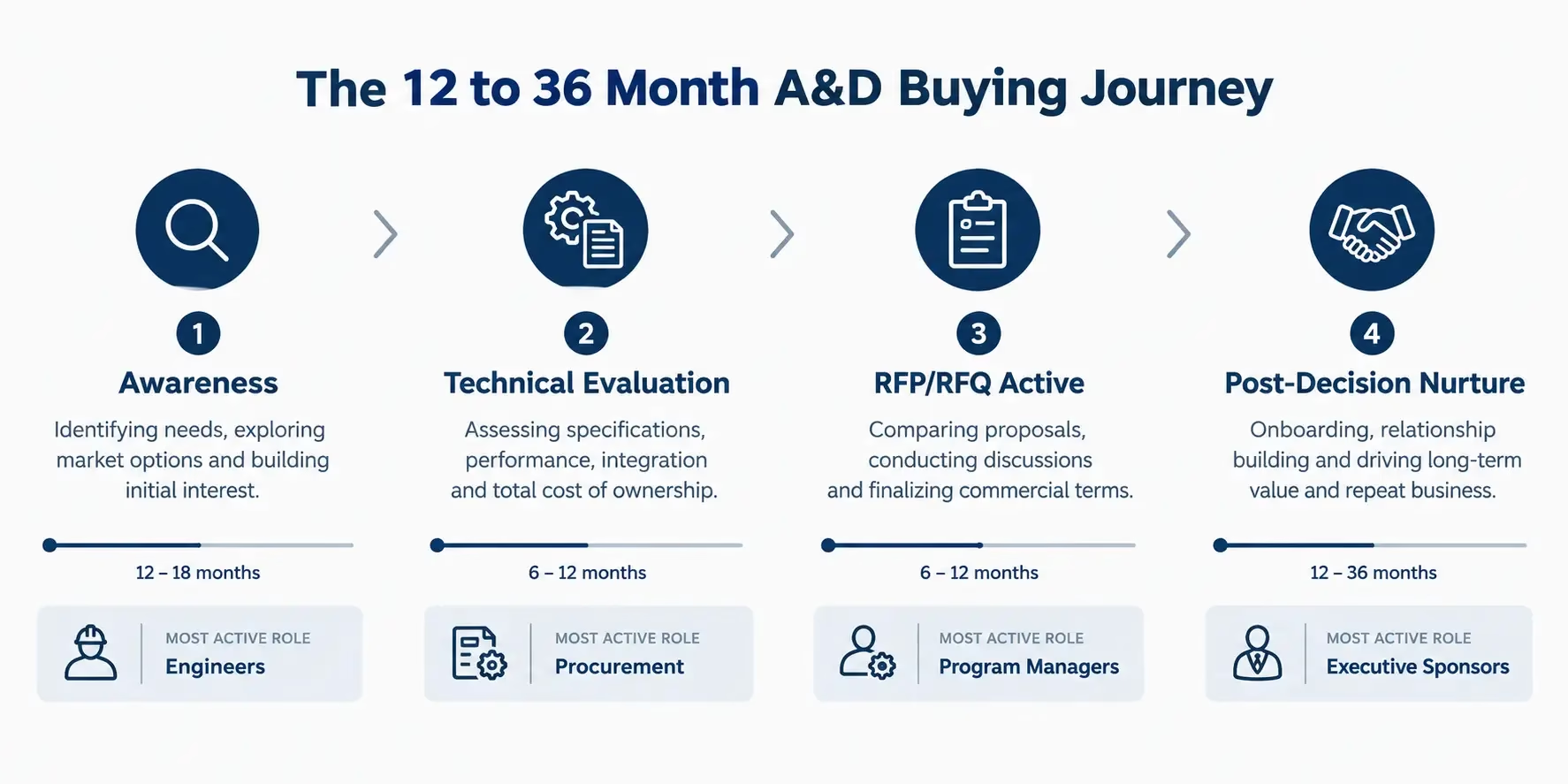
7. Building a Nurture Sequence for a 12 to 36 Month Sales Cycle
A nurture sequence built for a two-week sales cycle simply runs out of content and relevance long before an aerospace or defense deal closes. Sequences in this sector need to be built in stages tied to where a contact sits in a multi-year evaluation process.
| Stage | Typical Duration | Email Focus |
|---|---|---|
| Awareness | Months 1 to 3 | Capability brief, general technical credibility content |
| Technical Evaluation | Months 3 to 12 | Detailed spec sheets, case studies, compliance documentation |
| RFP/RFQ Active | Varies, often 2 to 6 months | Direct proposal support, acknowledgment sequences, rapid response to questions |
| Post-Decision Nurture (if not selected this cycle) | Ongoing | Light-touch relationship maintenance for the next procurement cycle |
The mistake most companies make is treating this as a single linear drip campaign. In reality, contacts move in and out of these stages unpredictably as budgets shift and programs get delayed, so the system needs to support re-entry into an earlier stage without looking broken or repetitive to the recipient.
8. Trade Shows and Event-Anchored Email Campaigns
Major industry events remain one of the most reliable sources of qualified contacts in this sector, and email built around these events consistently outperforms cold outreach.
Key events worth building campaigns around include:
- Paris Air Show
- Farnborough International Airshow
- AUSA (Association of the United States Army) Annual Meeting
- Space Symposium
Effective event-based email sequences typically follow this pattern: a pre-event email confirming a booth meeting or scheduling a conversation, a same-week follow-up referencing the specific discussion that took place, and a longer-term nurture email 30 to 60 days later tied to whatever the prospect indicated as their timeline during the conversation.
9. What Effective A&D Email Production Looks Like
Realistically, running this kind of program requires a different internal process than a typical marketing email calendar:
- Technical content reviewed by an engineer or subject matter expert before it goes into an email, not written entirely by the marketing team in isolation.
- A compliance checkpoint for any content referencing specific technical capabilities, export status, or classified program details.
- Segmentation and list management is done carefully by account and role rather than bulk list imports.
- Sending cadence is deliberately restrained, prioritizing relevance over frequency.
- Sales and marketing alignment is close enough that marketing knows which accounts are in active RFP status at any given time, since that changes what email should be sent next.
10. Common Mistakes That Kill Campaigns in This Sector
- Using retail-style urgency language. “Offer ends Friday” has no place in a sales cycle measured in years, and it damages credibility instantly with a technical audience.
- Sending the same message to every buying committee role. Procurement officers and engineers need entirely different content, not the same email with a different first name.
- Ignoring export control review before sending technical content. This is not optional, and skipping it can create genuine compliance exposure for the company.
- Overloading send frequency. Aggressive cadence gets flagged by hardened enterprise and government email security systems, sometimes at the domain level, damaging deliverability for every future email.
- Treating trade show leads like cold leads. A contact met at Farnborough or AUSA already has context, and an email that ignores that conversation resets the relationship back to zero.
11. Quick Reference Table
| Factor | Standard B2B Email | Aerospace & Defense Email |
|---|---|---|
| Sales cycle | Weeks to months | 12 to 36 months |
| Decision makers | 1 to 3 people | Full buying committee across multiple roles |
| Content tone | Persuasive, benefit-driven | Technical, document-style, restrained |
| Compliance layer | Minimal (CAN-SPAM, GDPR) | ITAR, EAR, DFARS, CMMC review |
| Deliverability challenge | Standard inbox filtering | Hardened government/enterprise gateways |
| Best-performing format | Promotional offers | Capability briefs, RFP support, ABM outreach |
12. Frequently Asked Questions
Is regular email marketing software enough for aerospace and defense campaigns?
Standard platforms can handle sending mechanics, but the strategy, content review process, and segmentation logic have to be built specifically for this sector. The tool matters less than the process wrapped around it.
How often should emails be sent to aerospace and defense contacts?
Far less frequently than a typical B2B cadence. Relevance matters more than frequency, and overly aggressive sending is one of the fastest ways to damage both deliverability and trust with this audience.
Does account-based marketing work better than list-based email in this industry?
For high-value target accounts, particularly major prime contractors, yes. The value of winning a single large account often justifies the extra effort of building highly customized, low-volume outreach rather than broad list campaigns.
What is the biggest deliverability risk specific to this sector?
Sending to .mil, .gov, or hardened contractor networks without proper SPF, DKIM, and DMARC alignment. These networks apply stricter filtering than typical corporate inboxes, and misconfigured authentication is a common, avoidable cause of emails simply never arriving.
Who should review email content before it goes out in this industry?
Ideally both a subject matter expert (to confirm technical accuracy) and a compliance or export control contact (to confirm the content does not cross into restricted technical disclosure), not marketing alone.
Where This Fits Into a Broader Marketing Strategy
Email is rarely the only channel in a serious aerospace and defense marketing program. It works best layered alongside LinkedIn outreach to the same named accounts, trade show presence, and technical content published on your own site that gives prospects something substantial to find during their long evaluation window.
If you’re building this kind of longer-cycle, multi-channel program rather than a single campaign, our digital marketing services cover the full setup, and our breakdown of how to run a marketing agency explains how we structure multi-channel campaigns operationally for clients with long, technical sales cycles. For companies weighing paid channels against long-cycle nurture, our guide on Facebook ad strategies is a useful contrast, since paid social plays a very different role than email does in this kind of buying process. You can also see how we’ve applied similar account-focused thinking for clients through our marketing agency overview, and our SEO services page covers how organic search complements email for capturing prospects already searching for technical solutions during that long evaluation window.