


Ask ten business owners what marketing means and most of them will say “advertising” or “social media posts.” That answer is not wrong, it is just incomplete. Advertising is one small piece of a much bigger system, and if you only focus on that one piece, you end up with pretty ads for a product that is priced wrong, hard to buy, or built without ever asking the customer what they actually wanted. The 7 functions of marketing framework exists to fix exactly that blind spot. It comes from marketing education curricula (most commonly taught through DECA and business school programs) as a way to break the entire marketing discipline into the actual jobs that need to get done, not just the visible ones.
We run a small agency, and the businesses that grow fastest are almost never the ones with the flashiest ad campaign. They are the ones who understand that promotion is function five out of seven, not function one. Let’s walk through all seven, in the order they actually matter for a growing business.
Table of Contents
- What Are the 7 Functions of Marketing
- Function 1: Marketing Information Management
- Function 2: Pricing
- Function 3: Product and Service Management
- Function 4: Distribution (Channel Management)
- Function 5: Promotion
- Function 6: Selling
- Function 7: Financing
- How the 7 Functions Work Together (Real Business Example)
- Common Mistakes Businesses Make With These Functions
- Quick Reference Table
- Frequently Asked Questions
1. What Are the 7 Functions of Marketing
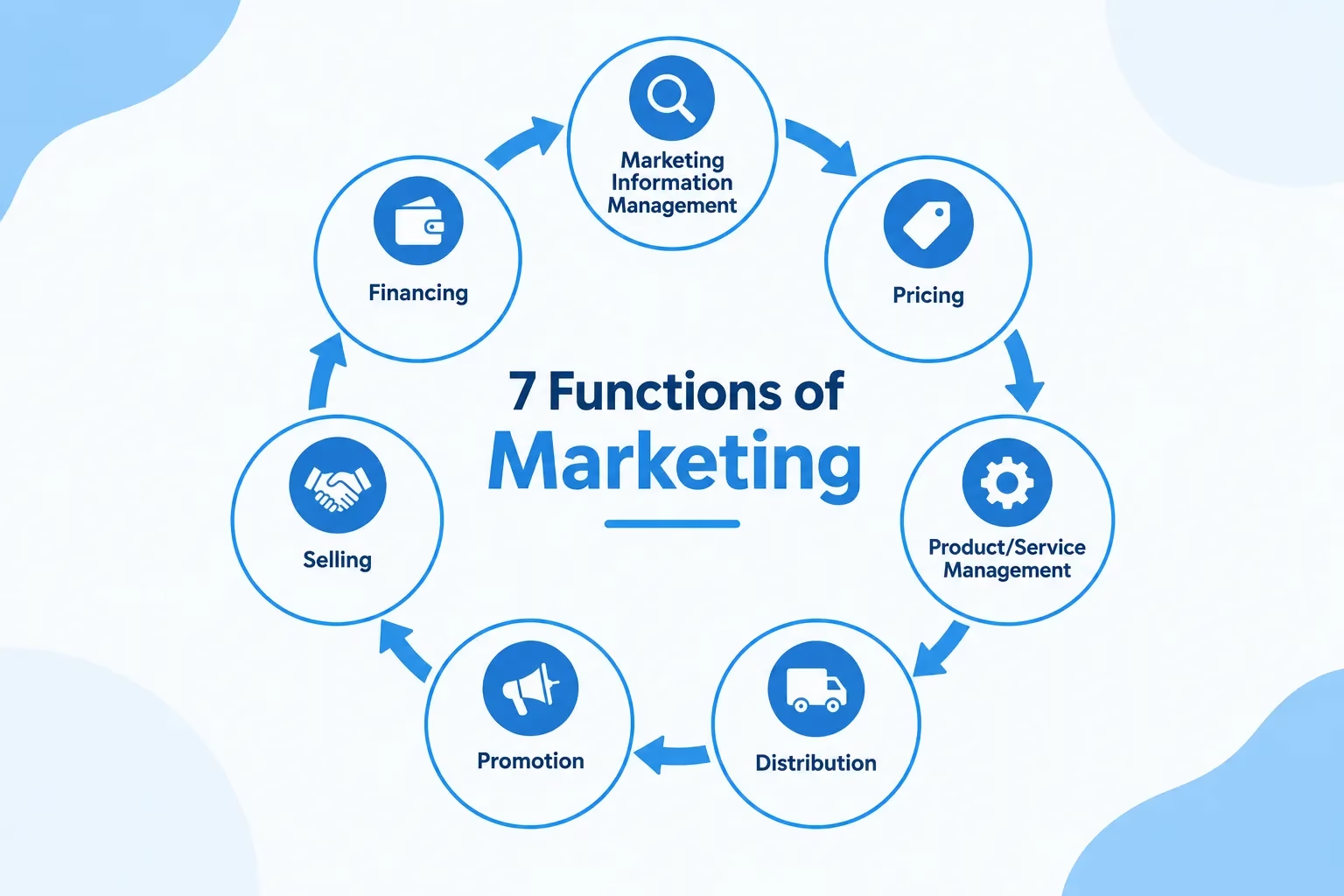
The seven functions are the core categories of activity that make up the full marketing process, from figuring out what customers want, all the way through to getting paid for it. They are:
- Marketing Information Management
- Pricing
- Product and Service Management
- Distribution (Channel Management)
- Promotion
- Selling
- Financing
Notice something important here: promotion, the thing most people equate with “marketing,” is function five. Two functions come before it, and one comes after it. If a business skips straight to running ads without doing the first four properly, the campaign is usually working against a weak foundation, not because the ad copy is bad, but because nobody answered the harder questions first.
2. Function 1: Marketing Information Management
This is the research function, and it is the one businesses skip most often because it feels slow compared to “just launching something.”
Marketing information management means systematically collecting and analyzing data about your customers, your competitors, and your market before you make decisions. It answers questions like:
- Who actually buys products like yours, and why
- What do competitors charge, and what do they offer that you don’t
- What complaints do customers repeatedly make about existing options in the market
- Is demand for this product growing, shrinking, or staying flat
Example: A local bakery wants to add a keto dessert line. Before spending money on ingredients or packaging, marketing information management means checking whether there is actual local demand (surveying existing customers, checking search volume for “keto desserts near me,” looking at what nearby competitors already offer) rather than guessing based on a national trend they saw online.
Tools commonly used here include customer surveys, Google Trends, competitor audits, and increasingly, direct social listening on platforms where your audience already talks.
3. Function 2: Pricing
Pricing is a marketing function, not just an accounting one, because price sends a message about positioning before a customer reads a single word of your marketing copy. A $12 candle and a $65 candle are marketed to two completely different people, even if the wax inside is nearly identical.
There are several standard pricing strategies businesses choose between:
| Strategy | How It Works | Best Used For |
|---|---|---|
| Cost-plus pricing | Add a fixed markup to production cost | Businesses with stable, known production costs |
| Value-based pricing | Price based on perceived customer value, not cost | Premium or differentiated products/services |
| Competitive pricing | Set price relative to competitors’ pricing | Commoditized markets with many similar options |
| Penetration pricing | Launch low to gain market share, raise later | New entrants into a crowded market |
| Premium pricing | Price high to signal exclusivity or quality | Luxury or status-driven purchases |
Example: Two software companies sell nearly identical project management tools. One prices at $9/month and markets to freelancers on a budget. The other prices at $49/month and markets to enterprise teams needing compliance features. Same category, completely different pricing function decisions, completely different customer bases.
4. Function 3: Product and Service Management
This function covers designing, adjusting, and maintaining what you actually sell so that it keeps matching what customers need, based on the research gathered in function one.
This is not a one-time decision made at launch. It is ongoing. Products get refined based on returns data, support tickets, reviews, and shifting customer expectations.
Key activities inside this function include:
- Developing new product features based on customer feedback
- Discontinuing underperforming products or services
- Adjusting packaging, sizing, or service tiers
- Managing product quality and consistency over time
- Branding decisions tied directly to the product itself (not the ad campaign around it)
Example: A SaaS company notices through support tickets that customers keep asking for a mobile app version. Product and service management is the function responsible for evaluating that feedback, deciding whether to build it, and prioritizing it against other requests, before marketing ever announces anything.
5. Function 4: Distribution (Channel Management)
Distribution answers one question: how does the product actually get from you to the customer. This function is invisible when it works well and painfully obvious when it doesn’t (empty shelves, “out of stock” banners, shipping delays).
Common distribution channels include:
- Direct-to-consumer, selling straight from your own website or store
- Retail partnerships, placing your product on shelves through third-party stores
- Wholesale, selling in bulk to distributors who resell to retailers
- E-commerce marketplaces, such as Amazon or Etsy
- Hybrid models, combining several of the above
Example: A skincare brand starts direct-to-consumer through its own website. Once demand grows, it adds a wholesale relationship with a regional pharmacy chain. The product did not change. The distribution function changed, and that decision affects pricing, packaging requirements, and even which promotional channels make sense next.
6. Function 5: Promotion
Here is the function most people think is the entirety of marketing. Promotion covers every activity used to inform, persuade, and remind potential customers that your product exists and is worth buying.
| Promotion Type | What It Does |
|---|---|
| Advertising | Paid placements to build broad awareness (search ads, social ads, TV, print) |
| Public Relations | Earned media coverage and reputation management |
| Sales Promotions | Limited-time discounts, bundles, or incentives to drive short-term action |
| Content Marketing | Blog posts, videos, and guides that build trust and organic visibility |
| Social Media Marketing | Building an audience and engagement directly on social platforms |
Example: A new gym in town could run Facebook ads, get a mention in the local newspaper, offer a “first month free” sales promotion, and post workout tips on Instagram. All four are promotion, but they serve different purposes: awareness, credibility, urgency, and community, respectively.
We go deeper into one specific promotional channel in our guide on Facebook ad strategies, and cover why social platforms matter for brand visibility more broadly in why social media marketing is important.
7. Function 6: Selling
Selling is the direct interaction that converts interest into an actual transaction. It is distinct from promotion because promotion creates awareness and desire at scale, while selling is usually a closer, more personal step, whether that happens through a salesperson, a checkout page, or a customer support chat that answers the final objection before purchase.
Selling includes:
- Identifying and qualifying leads generated by promotional activity
- Answering objections and questions directly from prospective buyers
- Closing the transaction (in person, over the phone, or through a digital checkout flow)
- Building repeat purchase relationships after the first sale
Example: A B2B software company runs promotion (webinars, LinkedIn ads, case study content) to generate leads. Those leads then go through a sales call where a rep answers specific questions, handles pricing objections, and closes the deal. The webinar was promotion. The call was selling.
8. Function 7: Financing
Financing is the function people forget most often, but it directly determines whether a customer can actually complete the purchase you have spent six other functions setting up. It covers how both the business and the customer manage the money side of a transaction.
This includes:
- Offering payment plans or installment options to customers
- Extending business credit to wholesale or retail partners
- Managing the cash flow required to produce inventory before it sells
- Providing financing partnerships (buy-now-pay-later services, in-house credit, leasing options)
Example: A furniture store sells a $2,000 sofa. Without a financing option, many customers walk away simply because they cannot pay the full amount upfront. Adding a “12 months, no interest” financing option, a decision made under this exact function, directly increases how many browsers convert into buyers, regardless of how good the promotion or the product itself is.
9. How the 7 Functions Work Together (Real Business Example)
Here is what it looks like when all seven functions operate as one connected system, using a fictional but realistic local coffee roasting business.
| Function | Applied Decision |
|---|---|
| Marketing Information Management | Survey shows local customers want ethically sourced beans and are willing to pay more for it |
| Pricing | Adopts value-based pricing, positioning above supermarket brands but below specialty imports |
| Product/Service Management | Sources directly from two certified fair-trade farms and adjusts packaging to highlight sourcing |
| Distribution | Sells direct-to-consumer online, plus wholesale to three local cafes |
| Promotion | Runs Instagram content showing the sourcing story, plus local PR through a food blogger feature |
| Selling | In-store staff trained to explain sourcing story to walk-in customers who ask about the higher price |
| Financing | Offers a subscription model (pay monthly, get beans shipped automatically) to smooth cash flow and lock in repeat customers |
Notice that no single function did the heavy lifting alone. The pricing decision only made sense because the research function confirmed people would pay for it. The promotion strategy only worked because it had a real sourcing story to tell, which came from the product management decision. This is the entire point of thinking in functions instead of just tactics.
If you are building this kind of full-funnel plan for your own business rather than just picking one tactic, our breakdown on how to run a marketing agency walks through how these pieces get structured operationally, and our marketing agency overview covers how we apply this exact framework for clients directly.
10. Common Mistakes Businesses Make With These Functions
- Jumping straight to promotion. Running ads before validating the product or pricing with real research usually just accelerates spending money on a weak offer.
- Treating pricing as an afterthought. Pricing set purely by “what feels right” instead of competitive and value research tends to leave money on the table or price out the exact customer the product was built for.
- Ignoring financing on higher-priced items. Any product or service above a customer’s typical impulse-spend threshold benefits from at least one flexible payment option.
- Confusing selling with promotion. A business can have excellent promotion generating plenty of interest, and still fail if nobody follows up to actually close the sale.
- Never revisiting product/service management. Products launched three years ago rarely still perfectly match what customers want today without ongoing adjustment based on feedback.
11. Quick Reference Table
| # | Function | One-Line Definition |
|---|---|---|
| 1 | Marketing Information Management | Researching customers, competitors, and market conditions |
| 2 | Pricing | Setting a price that reflects cost, value, and positioning |
| 3 | Product/Service Management | Designing and refining what you actually sell |
| 4 | Distribution | Getting the product from business to customer |
| 5 | Promotion | Building awareness and desire for the product |
| 6 | Selling | Converting interest into an actual transaction |
| 7 | Financing | Managing how the transaction is paid for |
12. Frequently Asked Questions
Is it 7 functions or 8 functions of marketing?
Most standard curricula, including DECA’s marketing education framework, teach seven functions. Some variations add “Marketing Planning” as an eighth overarching function that ties the other seven together, which is why you will occasionally see “8 functions of marketing” used interchangeably.
Which function is most important?
None of them work well in isolation, but marketing information management is arguably the foundation, since decisions made in pricing, product management, and promotion are only as good as the research behind them.
How is this different from the 4 Ps of marketing?
The 4 Ps (Product, Price, Place, Promotion) are a simplified strategic model. The 7 functions framework is broader and more operational, adding selling, financing, and information management as distinct categories rather than folding them into the four core Ps.
Do small businesses need to think about all 7 functions?
Yes, even informally. A solo business owner is still doing research (talking to customers), setting prices, managing their product, choosing how to sell (in person, online, both), promoting, closing sales, and deciding on payment terms. The functions exist at every business size, just with fewer people responsible for each one.
Where does digital marketing fit into these 7 functions?
Digital marketing touches several functions at once. Social media and content sit mainly under promotion, but data from digital channels (site analytics, ad performance, customer behavior tracking) also feeds directly into marketing information management.
Bringing the Framework Back to Your Business
The businesses that struggle with marketing are rarely missing creativity. They are usually missing structure, running promotion without research, or selling a product that was never properly priced for the customer it was built for. Working through these seven functions in order, even briefly, tends to surface the actual gap before more money gets spent trying to fix it with a bigger ad budget.
If you want help applying this framework to your own business rather than working through it alone, our digital marketing services are built around exactly this kind of full-picture approach rather than isolated campaign work.Sources